
Why isn’t your website showing on Google? A complete guide to improving visibility
Many online journeys begin with a search engine such as Google.
If your website doesn’t appear on Google, you’re missing out on visibility, customers and sales. It’s like opening a shop in the middle of the desert: hardly anyone will know you exist.
At SEOWebfy we work to help all kinds of businesses – from sole traders to established companies – escape ‘digital invisibility’ and appear where their customers are searching.
In this article you’ll discover:
- Why your website might not be on Google.
- The technical and strategic factors involved.
- Advanced SEO strategies.
- Practical examples.
- Future SEO trends.
- How to measure with KPIs.
- A seven-day implementation checklist.
📌 Whether you’re a sole trader, a small business or a larger company, this guide shows you how to go from being invisible online to turning your website into a steady source of visits and customers.
Why isn’t your website showing on Google?
A lack of visibility on Google usually comes down to three main factors: technical problems, a lack of optimised content and insufficient external authority.
- Failed indexing → if Google can’t read your website, it doesn’t exist as far as the search engine is concerned.
- Configuration errors → robots.txt or meta tags blocking access.
- Lack of relevance → poorly optimised or duplicate content.
- Insufficient authority → without external links, Google finds it harder to trust your website.
- Strong competition → in crowded sectors, reaching the top positions usually requires a more sophisticated SEO strategy.
👉 Tip: if you don’t submit your sitemap through Search Console, a new website may take longer to appear on Google.
Essential SEO factors for Google visibility
- Correct indexing → check robots.txt, meta tags and your sitemap.
- Loading speed → Google values fast websites (Core Web Vitals).
- On-page SEO → clear titles, a logical H1/H2 hierarchy and natural keywords.
- Technical SEO → URL structure, internal links, schema.org.
- External authority → backlinks from relevant publications, directories and blogs.
- Local SEO → an optimised Google Business Profile.
- Original content → useful, thorough articles with clear search intent.
- User experience → modern, responsive web design with simple navigation.
👉 Related: as with “Local SEO on Google Maps: attract customers in your area”, where optimisation can help businesses reach nearby customers, technical SEO also plays an important role in visibility.
The benefits of optimising your SEO
- Greater visibility → your website appears in relevant searches.
- More qualified traffic → visitors with genuine purchase intent.
- Credibility → appearing prominently in search results can help reinforce credibility.
- Less reliance on paid clicks → organic traffic doesn’t carry a media cost for each click.
- Better ROI → SEO is a long-term investment whose return can grow over time.

Advanced SEO strategies
- Semantic SEO: using synonyms and related terms to cover a wider range of relevant searches.
- In-depth content: comprehensive, well-structured guides where the topic calls for them.
- Advanced technical SEO: structured data and schema markup.
- Strategic link earning: relevant editorial partnerships, useful guest contributions and legitimate PR activity.
- Enhanced local SEO: dedicated pages by town or neighbourhood, plus genuine reviews.
- UX optimisation: modern web design can support engagement and make the site easier to use.
Practical examples
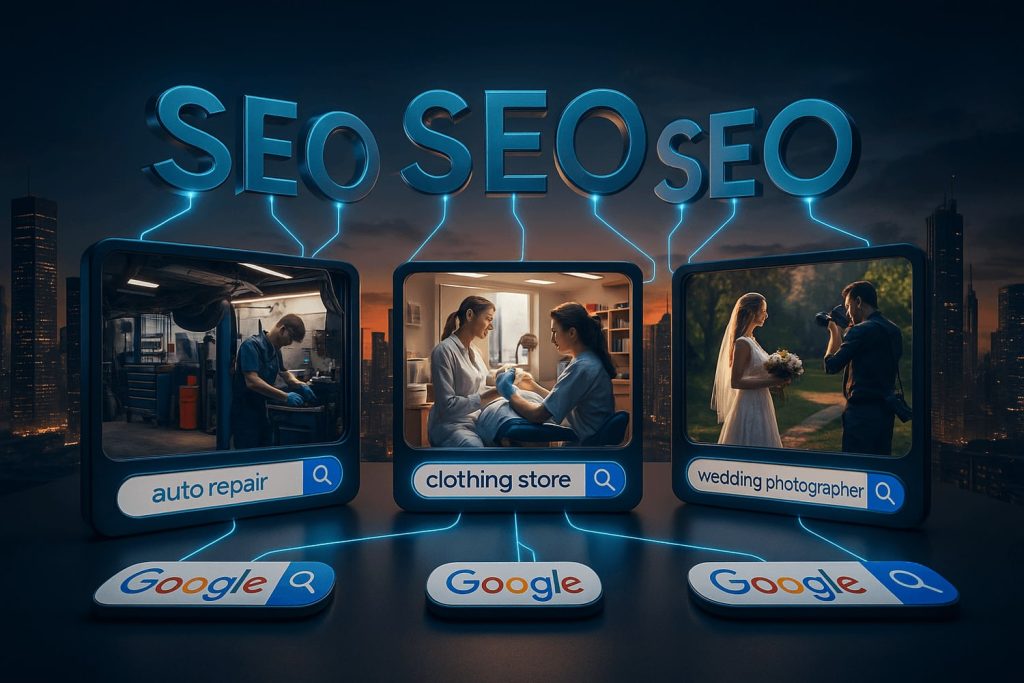
- Car repair garage → optimising its Google Business Profile to compete in local searches.
- Dental clinic → an FAQ blog to attract organic traffic.
- Sustainable fashion online retailer → combining influencer partnerships with content SEO to climb the rankings.
- Wedding photographer → combining local SEO with links from wedding directories to target the first page.
- Home renovation company → creating neighbourhood pages to attract more enquiries.
- English language school → publishing articles about Cambridge exams to attract prospective students.
Future trends in SEO
- AI and SEO → AI-assisted optimisation and AI-generated answers in search results.
- Voice search → conversational keywords (‘best café near me’).
- Visual SEO → greater emphasis on optimising images and video for discovery in search.
- E-E-A-T → Google values the experience, expertise, authoritativeness and trustworthiness of content.
- User-centred experience → speed, UX and accessibility as core pillars.

Competitive advantages
- You strengthen your position in your sector.
- A well-optimised website can support a stronger, more credible search presence.
- You can reach customers before your competitors do.
- You reduce advertising costs over the long term.
- You build loyalty: making information easy to find can support a better experience for returning visitors.
Common mistakes to avoid
- Copying content from other websites (it weakens originality and search performance, and manipulative practices may breach Google’s spam policies).
- Allowing important content to become outdated.
- Using vague titles.
- Ignoring loading speed.
- Not measuring or reviewing SEO metrics.
KPIs and performance measurement
- Average position on Google.
- Number of keywords in the top 10.
- Click-through rate (CTR) from search results.
- Monthly organic visits.
- Conversions from organic traffic.
👉 SEOWebfy tip: build a monthly dashboard in Looker Studio to track your progress.
Implementation checklist (seven-day plan)
- Day 1 → Check indexing in Search Console.
- Day 2 → Optimise titles, H1s, H2s and meta descriptions.
- Day 3 → Compress images and improve speed.
- Day 4 → Create or optimise your Google Business Profile.
- Day 5 → Write one thorough article that answers a key search.
- Day 6 → Request listings or links from two local directories or associations.
- Day 7 → Review your metrics in Search Console and Analytics.
Frequently asked questions
How long will it take for my website to appear on Google?
Google may take anywhere from a few days to a few weeks to crawl new or updated pages; indexing isn’t guaranteed, and ranking well usually takes longer.
Do I need to publish long articles?
Not necessarily: Google values content that is useful, original and answers the search. The right length depends on the topic.
Does local SEO really work?
Yes, when done properly: optimising your Google Business Profile and building genuine customer reviews can help you attract more nearby customers.
Is social media enough to rank?
No. Social media can support visibility, but it doesn’t replace making your website accessible, relevant and optimised for search.
Does SEO require ongoing attention?
Generally, yes. Competitors evolve and Google updates its algorithms.
Conclusion
Not appearing on Google is like not existing online.
The good news: with the right strategy, you can improve your visibility and create more opportunities to attract customers.
👉 At SEOWebfy we help businesses improve their visibility with advanced SEO and tailored strategies.
To take the next step, read our article “Modern web design: how to engage visitors and turn them into customers”.